Why 95% of AI Pilots Never Make It to Production — And What Mid-Market Companies Are Doing Differently
Your team ran the pilot. The demo worked. The vendor said it would be live in 90 days.
That was eight months ago.
If that sounds familiar, you’re not alone — and you’re not the problem. The data is unambiguous: 95% of organizations investing in AI are getting zero measurable return. That’s not a typo. Three independent research bodies — MIT’s Project NANDA, BCG, and McKinsey — arrived at the same figure from different angles, different sample sizes, and different methodologies. They all landed in the same place.
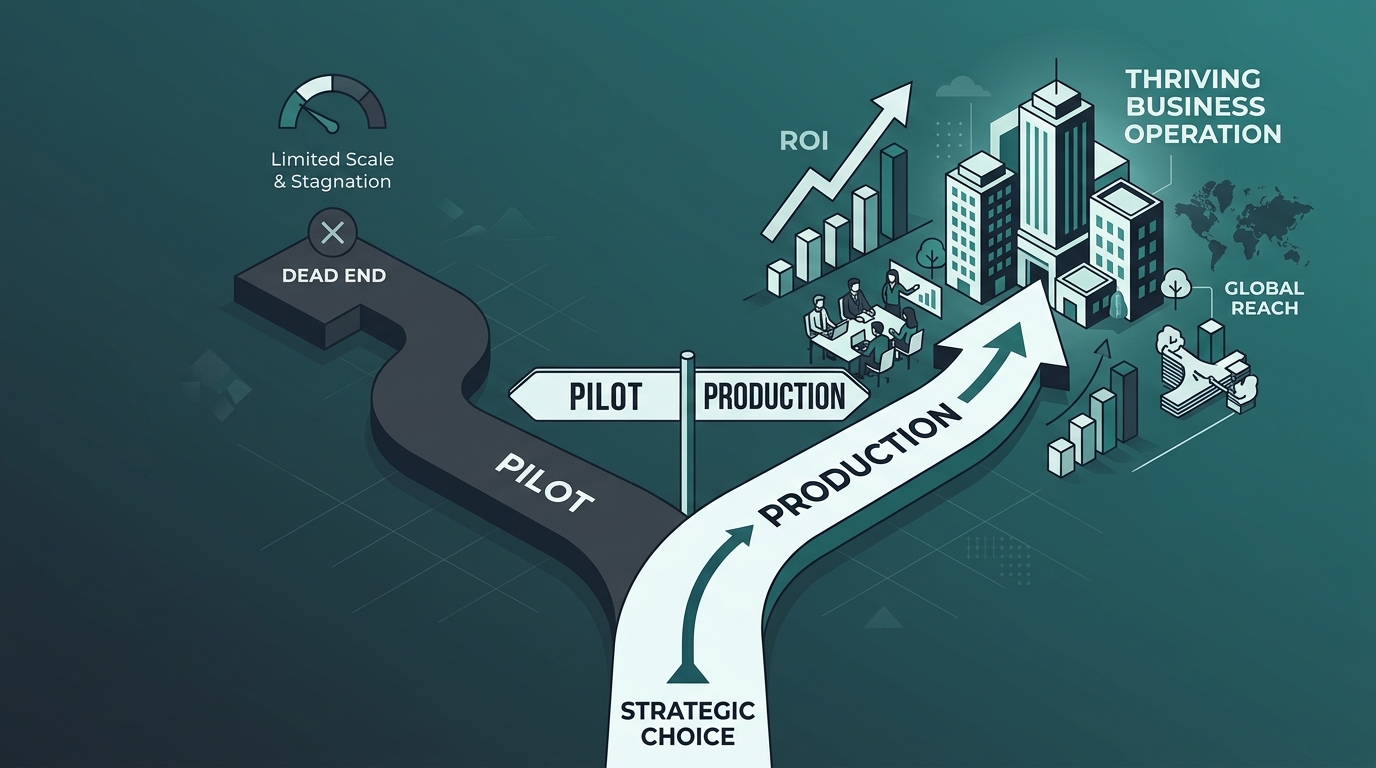
Most AI initiatives die between the pilot and production. The question worth asking isn’t why AI fails in the abstract. It’s why yours specifically might be at risk — and what the 5% doing it right actually have in common.
The Gap Between “We’re Using AI” and “AI Is Working”
There’s a meaningful difference between AI experimentation and AI deployment. RSM’s 2025 Middle Market Survey (966 mid-market companies, $5M–$200M revenue) found that 91% of mid-market firms are now using generative AI — up from 77% the year before. But only 1 in 4 reported AI fully integrated into core operations. Broad adoption, thin impact.
IDC and Lenovo put the pilot failure rate at 88%: nearly nine out of ten proof-of-concepts never reach production. Gartner’s 2026 I&O survey found only 28% of AI use cases fully succeed. S&P Global reported that in 2025, 42% of companies abandoned most of their AI initiatives — up from 17% the year prior.
This isn’t a technology problem. The tools work. The models are capable. The issue is almost always organizational.
What’s Actually Killing AI Pilots
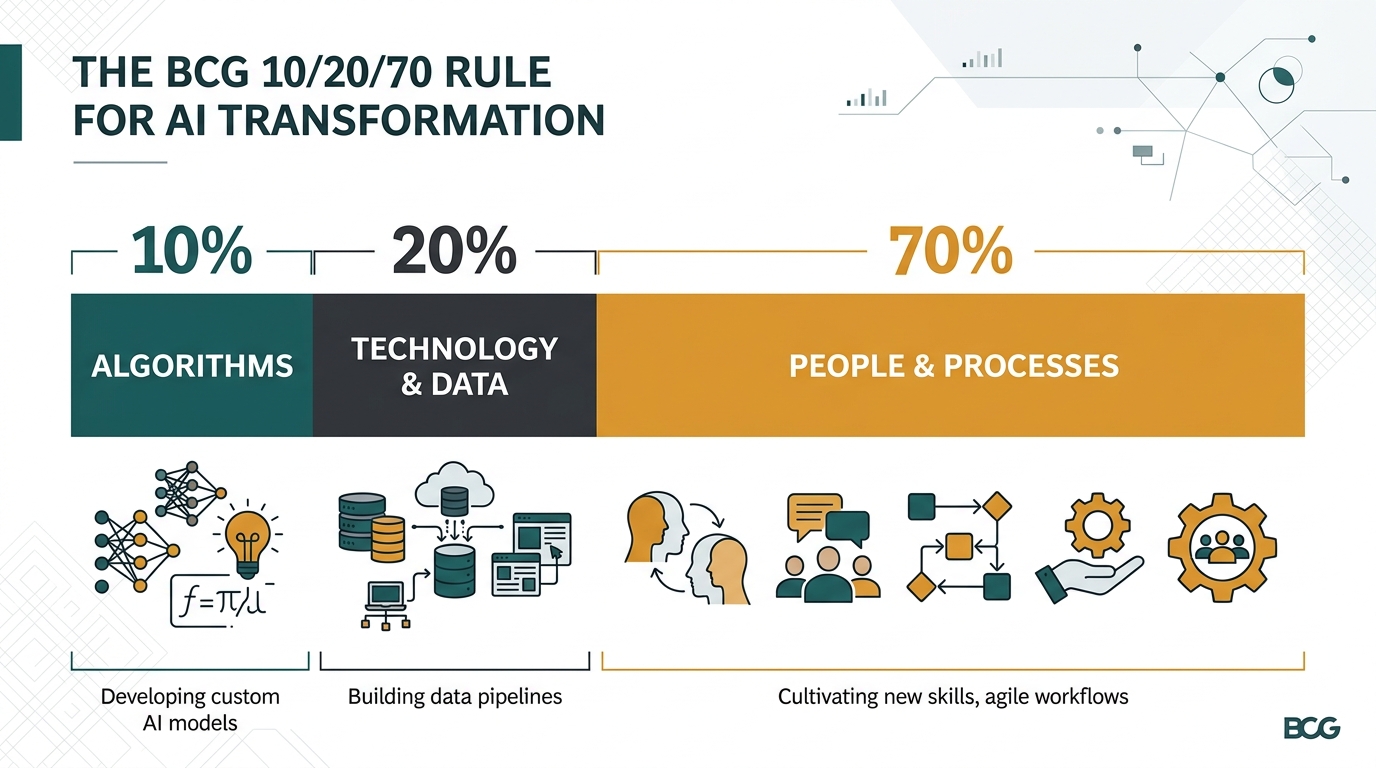
BCG’s research produced what’s become known as the 10/20/70 rule: in any AI transformation, 10% of the outcome depends on algorithms, 20% on technology and data, and 70% on people, processes, and organizational change.
Most AI investments get this exactly backwards. Companies spend budget on model selection, infrastructure, and vendor contracts — then discover that the hardest part was never the technology. It was the change management. The workflow redesign. The team that doesn’t trust the output. The executive who doesn’t know how to interrogate a recommendation from a model.
The other major factor: lack of in-house expertise. RSM found that 70% of mid-market companies say they need outside help to implement AI — not because they lack intelligence, but because successful AI transformation requires a combination of technical, operational, and change management skills that most leadership teams haven’t had to develop before.
There’s also a structural issue unique to mid-market: unlike large enterprises, you don’t have a Chief AI Officer, a dedicated ML team, or an innovation lab running parallel experiments. And unlike smaller companies, you have enough operational complexity that AI mistakes have real downstream consequences. The margin for error is smaller, and the resources to absorb it are more limited.
What the 5% Do Differently
The organizations generating measurable returns from AI share a few consistent patterns:
They define success before they start. Not “we want to use AI” — but “we want to reduce invoice processing time by 40% within 90 days.” Specific, measurable, tied to a real business outcome. MIT’s research found that top-performing mid-market implementations move from pilot to full deployment in 90 days. That timeline requires knowing exactly what you’re measuring from day one.
They embed AI into existing workflows rather than building parallel ones. The most expensive AI initiative is the one that runs beside your actual operations but never becomes part of them. Successful deployments redesign the workflow first, then put AI inside it — not the other way around.
They treat the people problem as the actual project. Training, change management, and stakeholder alignment aren’t afterthoughts — they’re the majority of the work. BCG’s 70% isn’t abstract. It shows up as: the sales rep who ignores the AI-recommended next action, the manager who manually re-does the AI’s work because they don’t trust it, the leader who championed the initiative but doesn’t use it themselves.
They have someone accountable for outcomes, not just delivery. The traditional consulting model delivers a recommendation — then leaves. The traditional SaaS model delivers a login — then sends invoices. Neither model is accountable for whether the business outcome actually happens. The organizations seeing real returns have a partner who shares accountability for what results, not just what gets built.
Agent Operations: A Different Way to Think About AI in Your Business

One of the emerging frameworks for sustainable AI deployment — and the one we build around at Zen Aegis — is agent operations: treating AI not as a tool your team uses occasionally, but as a layer of operational capacity that runs alongside your core business.
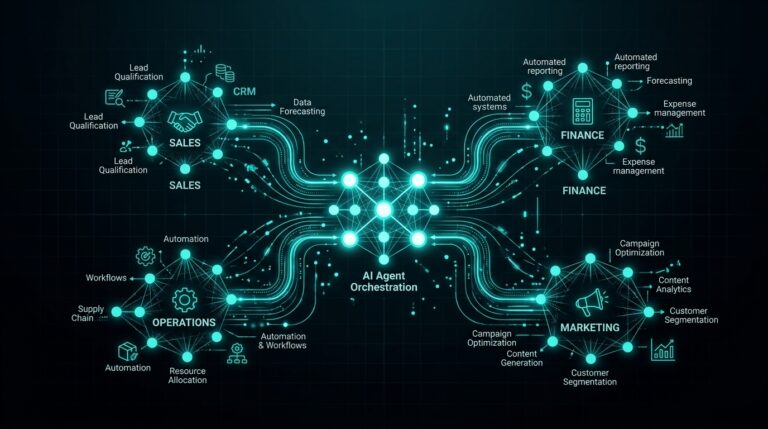
Agent operations means AI agents handling defined, repeatable workflows — not replacing judgment, but handling the execution layer so your team focuses on the decisions that actually require human insight. Think: lead qualification and routing, contract first-pass review, competitive monitoring, internal knowledge retrieval, project status summarization. The work that’s important but shouldn’t require your highest-paid people to do it manually.
Done correctly, agent operations doesn’t require a massive infrastructure investment or a year-long implementation. It requires clear process documentation, good data hygiene, and a deployment partner who understands both the technical and the organizational side.
Done incorrectly, it’s another pilot that doesn’t make it to production.
The Honest Assessment
If you’re in the 88% whose AI initiative is stalled between pilot and production, there are usually three root causes:
- The use case wasn’t specific enough. “Use AI in our operations” is not a use case. “Reduce time-to-quote by 30% for your enterprise sales cycle” is a use case.
- The change management wasn’t resourced. Technology got the budget. People didn’t. The tools work; the adoption doesn’t.
- Accountability stopped at delivery. Someone built a thing. Nobody owns what happens after.
The regulatory environment is adding urgency to an already complex picture. The Colorado AI Act takes effect June 30, 2026. The EU AI Act August 2, 2026. RSM found that 53% of mid-market firms feel only “somewhat prepared” for what’s coming. These aren’t distant enterprise concerns — they apply to any mid-market company deploying AI in consequential decisions around employment, lending, insurance, or healthcare.
Where to Start
If you’re unsure where you actually stand — whether your current AI initiatives are on a path to production or quietly becoming statistics — an honest readiness assessment is the right first step.
Not a sales pitch. Not a vendor demo. An honest accounting of: what you have, what’s working, what’s not, and what a realistic path to production looks like for your specific business.
That’s the work we do. Zen Aegis is an embedded AI transformation partner for mid-market companies. We don’t leave a deck. We don’t leave a login. We stay until AI is working inside your operations and your team can sustain it without us.
If you want to understand where you actually stand, start with our AI Readiness Assessment. It takes two weeks. It’s the clearest picture of your AI posture you’ll have — and it’s the same starting point we use for every engagement.
Sources: MIT Project NANDA “The GenAI Divide” (July 2025); BCG “The Widening AI Value Gap” (September 2025, n=1,250); McKinsey “State of AI 2025” (November 2025, n=1,993); RSM Middle Market AI Survey 2025 (n=966); IDC/Lenovo via CIO.com; S&P Global “AI Use Cases 2025”; Gartner I&O Survey (April 2026); Colorado AI Act (SB 205); EU AI Act (Regulation 2024/1689)